
Trusting God Through Life Changes | TBCS
Just when life begins to feel familiar, something changes.
A relationship shifts. A responsibility grows. A door closes. The routine that once worked no longer fits, and you find yourself wondering, “Lord, what do I do now?”
You may not be able to stop the change. But you can choose how you respond to it.
God invites us to meet changing seasons with faith, wisdom, and a willingness to obey. We do not have to understand every detail before taking the next faithful step.
Quick Rundown
Life changes, but God remains faithful. When you enter a new season:
Trust God through uncertainty. A difficult season does not mean He has abandoned you.
Make room for what He is doing now. Remember His past faithfulness while remaining open to His direction today.
Adapt with wisdom. Adjust your habits and expectations while staying grounded in biblical truth.
Stay rooted in prayer and obedience. Seek wise counsel, give important decisions thoughtful attention, and take your next faithful step.
Start here: Ask, “Lord, what is one thing I can do today to respond faithfully to this season?”

Change Is Part of Life, and God Is Still Faithful
Some changes are welcome. Others bring grief, uncertainty, or responsibilities we would never have chosen.
Ecclesiastes 3:1 reminds us that life includes different seasons. Recognizing that truth does not make every transition easy, but it helps us release the expectation that life should always stay the same.
James 1:2–4 teaches that the testing of our faith produces patience and that perseverance has a maturing work to do in us. This does not mean pain is pleasant or that we should pretend to enjoy suffering. It means hardship does not have to be wasted.
A difficult season is not proof that God has abandoned you.
You can be honest about your disappointment and still trust His character. You can grieve what has changed and still believe He will help you move forward.
Instead of asking only, “How can I get things back to the way they were?” consider asking, “How can I remain faithful to God where I am today?”
That question turns your attention toward a step you can actually take.
For encouragement in difficult seasons, read Unwavering Worship: Praising God in Every Season.

Make Room for What God Is Doing Now
It is natural to reach for what is familiar. Yesterday’s routine feels safer than tomorrow’s uncertainty.
But familiarity can become a place where we stop listening.
In Isaiah 43:18–19, God speaks to His people about a new thing He will do, using the picture of a way in the wilderness and rivers in the desert. In its original setting, this passage gives Israel hope in God’s restoring work. It also reminds us that His ability to work is not limited to what we have already experienced.
Remembering God’s past faithfulness strengthens us. Insisting that He must work in exactly the same way can keep us from recognizing what is before us.
Perhaps a previous season gave you an opportunity to lead. This one may require you to learn. Perhaps you once had a full schedule of visible service. Now faithfulness may look like caring for someone quietly, rebuilding healthy habits, or studying Scripture more deeply.
Different does not automatically mean less meaningful.
At the same time, every new opportunity is not necessarily God’s direction. Test what you are considering against Scripture, seek wise counsel, and pray for discernment.
The goal is not to chase something new. It is to remain attentive to God.
Explore how surrender and preparation help us respond to God’s direction in Give God Room: How to Prepare for a New Season.
Adapt Your Approach Without Letting Go of Biblical Truth
Adapting can feel uncomfortable, especially when the old approach served you well.
Yet a changing season may require a different schedule, a new skill, a healthier boundary, or a willingness to receive help.
Your commitment to Christ can remain steady while your methods change.
For example, if your responsibilities have increased, your time in the Word may need to move to a different part of the day. If your circumstances have changed, serving others may take a different form. If a relationship has become difficult, you may need wise counsel rather than continuing the same conversation with the same results.
Adaptation is not surrendering your convictions. It is applying them wisely to your present circumstances.
Ask yourself:
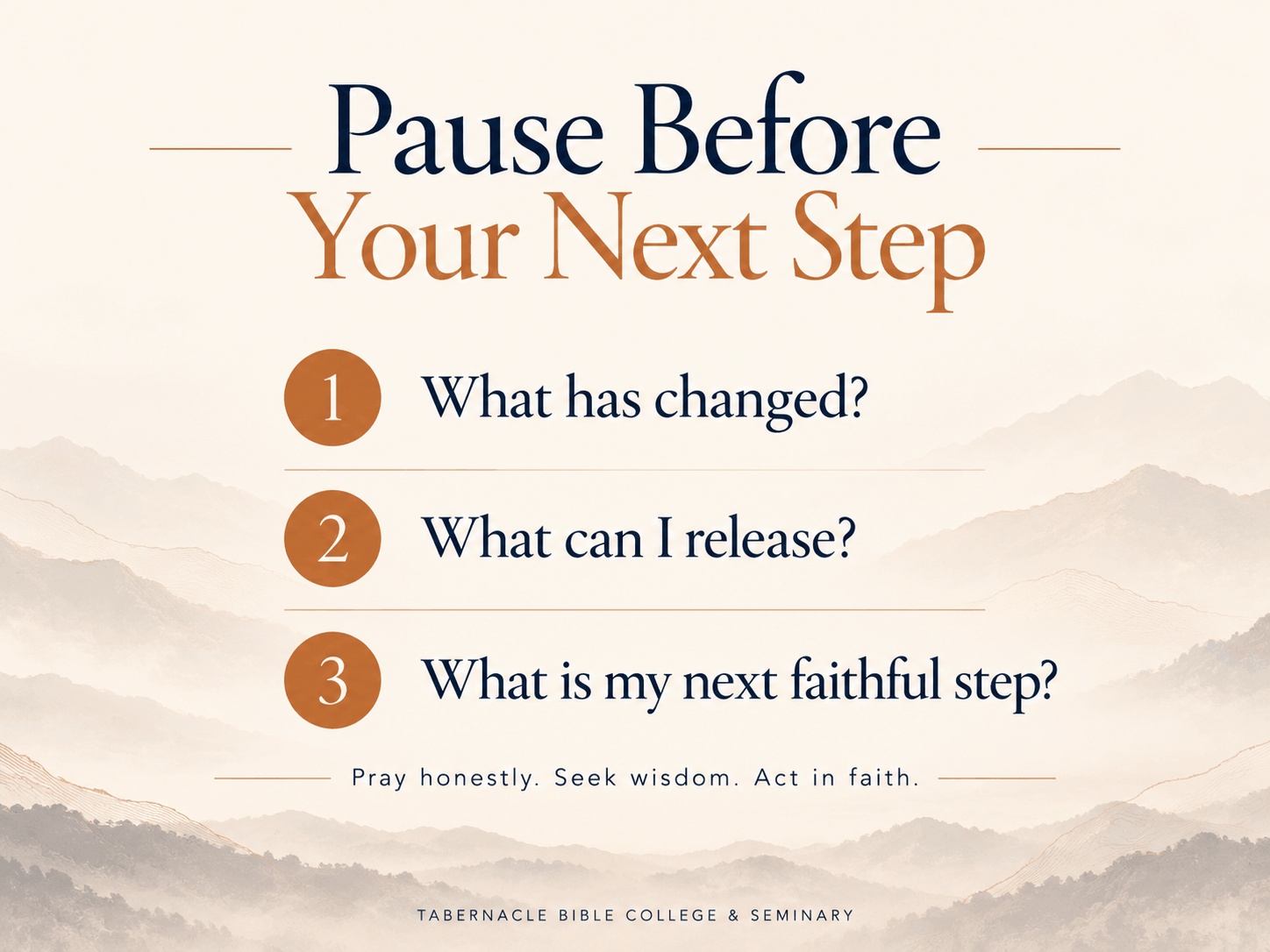
What has actually changed?
What responsibility is mine to address?
What habit or expectation no longer fits this season?
What biblical principle should guide my response?
You do not have to solve everything at once. Identify one adjustment that would help you live faithfully today, and begin there.
Stay in a Posture of Prayer, Wisdom, and Obedience
We often call this “staying in position.”
That does not mean staying in the same job, location, or routine forever. It means remaining responsive to God through prayer, His Word, wise counsel, and obedience.
Revelation 4:1 describes John receiving an invitation to see what God would show him. This is part of a specific vision, rather than a promise that every life transition will come with a dramatic revelation. Still, the passage directs our attention toward God’s perspective rather than our immediate surroundings alone.
When life changes, our first reaction is not always our wisest response.
Exhaustion can make everything feel urgent. Loneliness can make an unhealthy opportunity look appealing. Fear can push us to decide before we have considered the consequences.
When a decision can safely wait, give yourself room to rest, pray, and seek counsel before making a major commitment. When action is necessary, ask for help and take the wisest available step.
Proverbs 3:5–6 calls us to trust the Lord rather than rely entirely on our own understanding. Trust is not passivity. It is bringing our choices under His direction.
Sometimes the next step will be clear. Sometimes you will have enough light for only one step.
Obey what Scripture makes clear while you continue seeking wisdom about what remains uncertain.
Five Ways to Respond to Change This Week
1. Bring your feelings to God honestly.
Name the fear, disappointment, or grief you have been carrying. You do not have to hide it to pray faithfully.
2. Practice gratitude without denying the difficulty.
Write down three ways God has sustained you. Gratitude and grief can exist in the same heart.
3. Identify what you need to release.
It may be resentment, an unrealistic expectation, or the demand that this season must look like the last one. Forgiveness does not remove the need for wise boundaries.
4. Make one practical adjustment.
Change a routine, ask for help, or take care of a responsibility you have been avoiding. Choose something specific and manageable.
5. Return to the Word before rushing toward an answer.
Read James 1:2–5 and Proverbs 3:5–6. Consider what these passages reveal about perseverance, wisdom, and trust. Then choose one action that reflects what you have read.
Questions for Reflection
Take a few quiet minutes to consider these questions:
Am I spending more time replaying what happened than responding faithfully to what is happening now?
What am I afraid I will lose if I adapt?
Have I mistaken a difficult circumstance for evidence that God is unfaithful?
Am I allowing fear or exhaustion to drive a decision that could wait?
What is one step of obedience I already know I need to take?
You may find it helpful to write your answers and discuss them with a trusted pastor, mentor, or mature believer.
Sometimes our assumptions keep us from seeing where we need to grow. Explore Spiritual Blind Spots: The Gap You Can’t See for further reflection.
A Prayer for a Changing Season
Father, You know what has changed and how it has affected me. Help me bring You my fears instead of allowing them to direct my choices. Give me wisdom to recognize what needs to change, courage to release what I cannot carry forward, and patience when the next step is unclear. Keep me grounded in Your Word. Help me trust Your faithfulness and obey You in the season I am living now. In Jesus’ name, amen.
Keep Growing Where You Are
You do not need a complete picture of the future to be faithful today.
Begin with what is clear. Pray honestly. Open your Bible. Seek wise counsel. Take the next obedient step.
The circumstances around you may keep changing. God’s faithfulness gives you a steady foundation as you move through them.