
Don't Let Your Mouth Outrun Your Wisdom
Quick Rundown
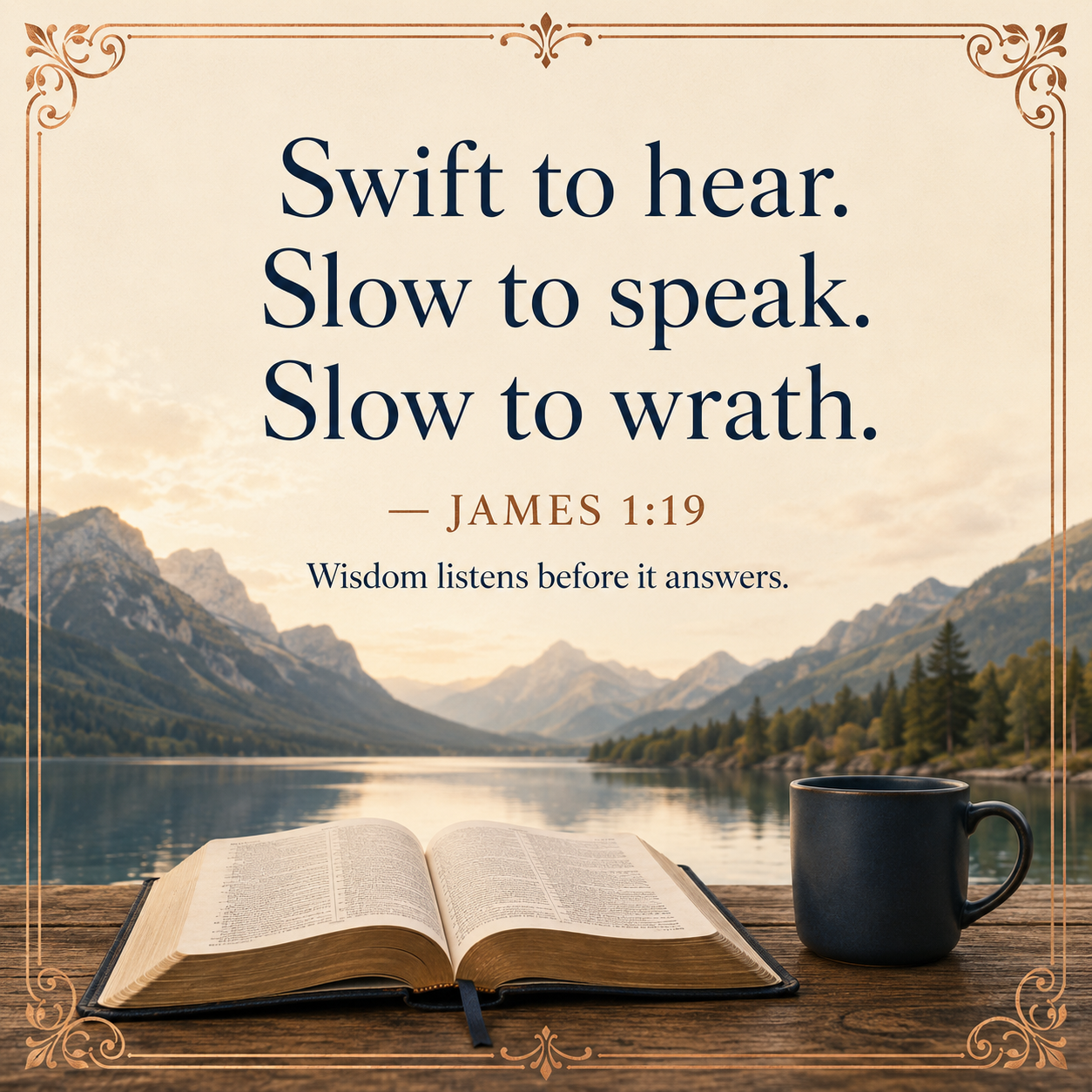
Wisdom is not simply knowing what to say. It is also knowing when to speak, how to speak, and when silence is wiser. James 1:19 tells believers to be “swift to hear, slow to speak, slow to wrath” (NKJV). Proverbs likewise connects wisdom with restraint. The biblical pattern is clear: listen carefully, resist impulsive reactions, seek God’s wisdom, and then speak with truth and grace.
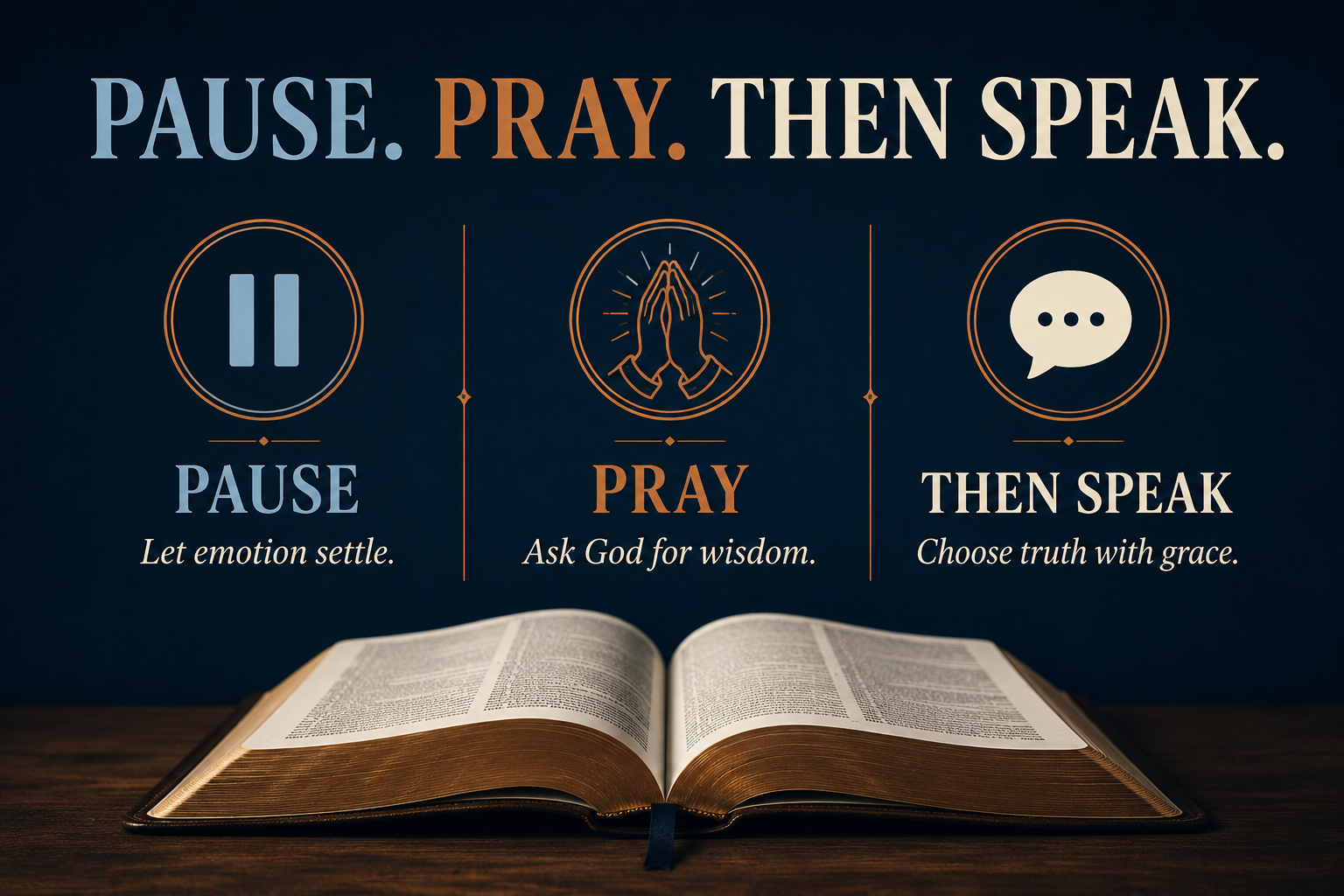
In other words: Pause. Pray. Then speak.
What Does It Mean to Keep Your Mouth From Outrunning Your Wisdom?
“Don’t let your mouth outrun your wisdom” is not a direct Bible verse. It is a practical way of expressing an important biblical principle: our words should be governed by wisdom rather than impulse.
Our mouths outrun our wisdom when we speak before we understand, answer before we listen, criticize before we consider the facts, or allow anger to choose our words.
Scripture points us toward a different way.
James writes:
“So then, my beloved brethren, let every man be swift to hear, slow to speak, slow to wrath.”
— James 1:19, NKJV
The order is worth noticing. Listening comes first. Speaking comes later.
Biblical wisdom does not demand that we remain silent in every situation. There are times when truth must be spoken clearly. But wisdom teaches us not to confuse an immediate response with a wise response.
Sometimes the most spiritual thing we can do before opening our mouths is wait.
The Biblical Connection Between Wisdom and Restraint
The book of Proverbs frequently connects wisdom with control over our speech.
Proverbs 10:19 says:
“In the multitude of words sin is not lacking, but he who restrains his lips is wise.”
— Proverbs 10:19, NKJV
The warning is simple. The more carelessly we talk, the more opportunities we create to say something sinful, foolish, inaccurate, cruel, or unnecessary.
Proverbs 17:27 reinforces the point:
“He who has knowledge spares his words, and a man of understanding is of a calm spirit.”
— Proverbs 17:27, NKJV
Notice that biblical wisdom is associated not only with knowledge but also with calmness and restraint.
A wise person does not need to comment on everything.
A wise person does not need to win every argument.
A wise person does not need the last word.
Wisdom knows that words have consequences.
Why a Pause Can Be an Act of Spiritual Maturity
Many words we regret were spoken too quickly.
Someone criticizes us, and we immediately defend ourselves.
A family member says something hurtful, and we return the injury.
An email frustrates us, and we type our response while our emotions are still high.
Someone misunderstands us, and we feel compelled to correct the record immediately.
Those moments reveal why a pause can be so valuable.
Pausing is not weakness. It is not cowardice, and it does not mean refusing to address a real problem.
A pause simply creates room between what happened and how we respond.
That small space gives us an opportunity to listen more carefully, examine our motives, seek God’s wisdom, and decide whether the words forming in our minds should actually leave our mouths.
This is where the central reminder becomes practical:
Pause. Pray. Then speak.
Pause: Do Not Let Emotion Choose Your Words
Emotions are real, but they are not always reliable guides for speech.
Anger can make harshness feel justified.
Hurt can make retaliation feel reasonable.
Fear can make an immediate response feel necessary.
Pride can make silence feel like defeat.
Scripture gives us a better standard.
Proverbs 15:1 says:
“A soft answer turns away wrath, but a harsh word stirs up anger.”
— Proverbs 15:1, NKJV
A gentle response does not guarantee that another person will respond well. Nor does this verse mean Christians must avoid difficult conversations.
It does mean that how we speak matters.
Truth does not become more truthful because we deliver it harshly.
Correction does not become more righteous because we deliver it angrily.
Sometimes wisdom requires firm words. But biblical firmness and uncontrolled anger are not the same thing.
Maturity helps us recognize the difference.
Pray: Invite God Into the Conversation Before You Answer
Prayer changes the posture of the person who is about to speak.
Instead of asking only, “What do I want to say?” prayer helps us ask:
“What response would honor God?”
“Am I speaking from love or irritation?”
“Do I understand the whole situation?”
“Am I trying to help, or am I trying to win?”
“Will my words bring clarity or simply release my frustration?”
The prayer does not have to be long.
It may be nothing more than:
“Lord, give me wisdom.”
“Help me listen.”
“Guard my attitude.”
“Help me speak truth with grace.”
“Keep anger from controlling my words.”
Those few seconds of dependence on God can change the direction of a conversation.
Prayer reminds us that our speech belongs under the lordship of Christ just as surely as our actions, decisions, relationships, and habits do.
Then Speak: Choose Words That Build Up
Christian wisdom is not merely about avoiding harmful speech. Scripture gives our words a positive purpose.
Ephesians 4:29 tells believers:
“Let no corrupt word proceed out of your mouth, but what is good for necessary edification, that it may impart grace to the hearers.”
— Ephesians 4:29, NKJV
That gives us a better question than simply asking, “Is it wrong for me to say this?”
We can also ask:
What will these words accomplish?
Will they build up?
Will they clarify the truth?
Will they encourage someone who is struggling?
Will they correct a problem without unnecessarily humiliating the person?
Will they help restore a relationship?
Will they communicate grace?
Will they make peace more possible?
Or will they simply make me feel better for having said what was on my mind?
A wise speaker thinks about the effect of words before speaking them.
Being Right Is Not the Same as Being Wise
One of the most difficult lessons in Christian communication is that we can be factually correct and still speak unwisely.
We may have the right information but the wrong tone.
We may identify a legitimate problem but address it at the wrong time.
We may give necessary correction in front of people who did not need to hear it.
We may tell the truth with a motive shaped more by pride than love.
We may even win the argument and damage the relationship.
Biblical wisdom therefore asks a larger question than, “Am I right?”
It asks:
“Am I handling what is right in a way that honors Christ?”
Sometimes wisdom speaks boldly.
Sometimes wisdom asks another question.
Sometimes wisdom waits until emotions settle.
Sometimes wisdom speaks privately rather than publicly.
Sometimes wisdom apologizes.
Sometimes wisdom decides that nothing more needs to be said.
Restraint does not mean refusing to speak. It means refusing to let impulse decide when and how we speak.
Your Words Reveal What Is Happening in Your Heart
Speech problems are often heart problems before they become mouth problems.
Jesus repeatedly connected a person’s speech with what is taking place within the heart. That means recurring patterns of bitterness, sarcasm, contempt, dishonesty, gossip, pride, or uncontrolled anger should not be treated only as communication problems.
They give us an opportunity for spiritual examination.
We may need to ask:
Why do I always need the final word?
Why does correction make me defensive?
Why am I so determined to prove myself?
Why do I speak differently about people when they are not present?
Why do I become careless with words when I am frustrated?
Why do I enjoy repeating information that damages someone else?
Growing in wise speech involves more than learning better phrases. It requires allowing God to work within us.
Wise words are most likely to flow from a heart that is being shaped by God’s Word.
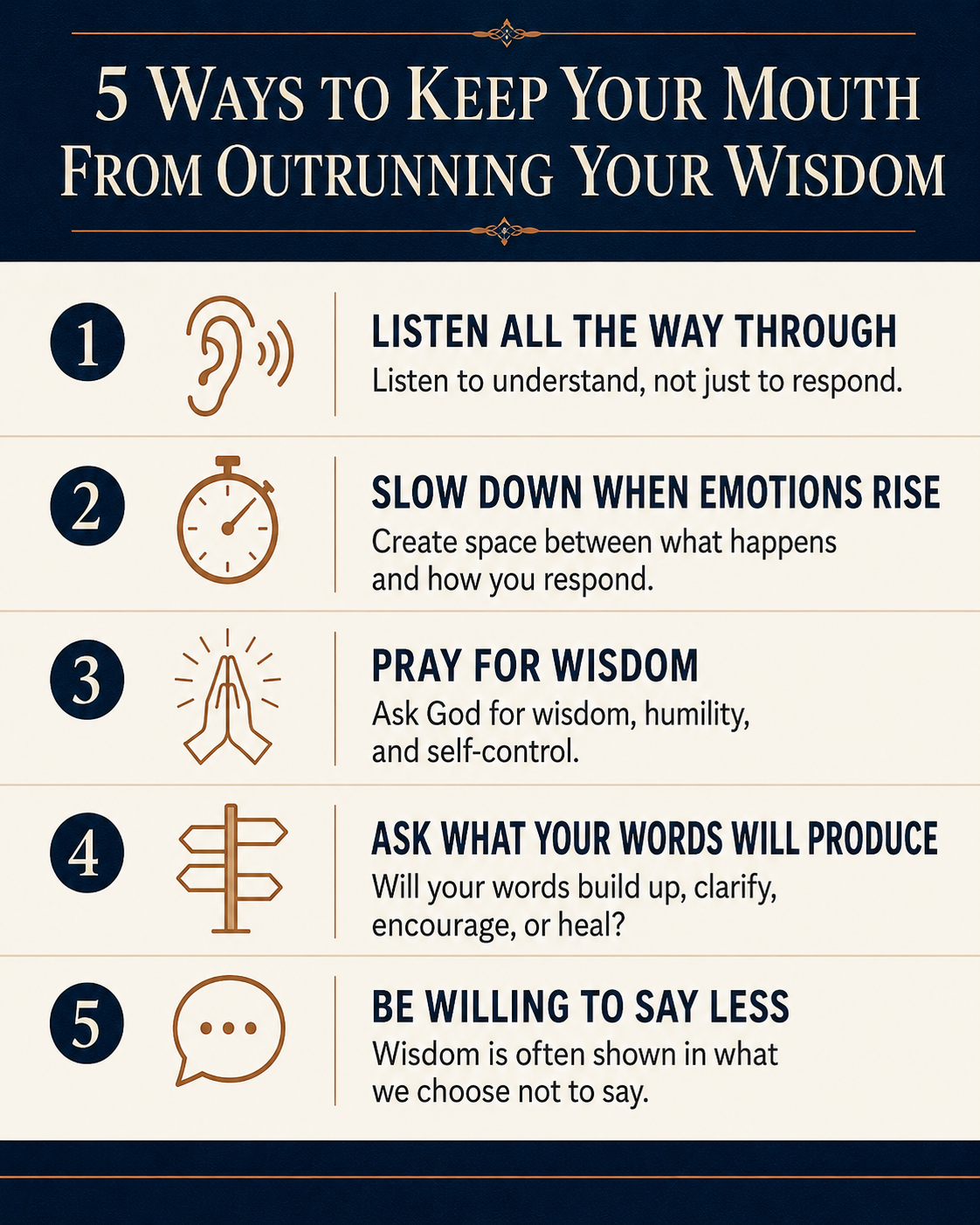
Five Ways to Keep Your Mouth From Outrunning Your Wisdom
Listen All the Way Through
Do not spend the entire time another person is speaking preparing your response.
Listen to understand.James 1:19 places hearing before speaking. That principle alone could transform many marriages, friendships, churches, workplaces, and family conversations.
Sometimes what we thought we needed to say changes after we have actually listened.
Slow Down When Emotions Rise
Pay attention to what is happening inside you.
If your heart is racing, your voice is getting louder, or you feel an intense need to answer immediately, consider pausing.
You may need five seconds.
You may need five minutes.
In some situations, you may need to revisit the conversation later.
The goal is not avoidance. The goal is to respond rather than react.
Pray for Wisdom
Before a difficult conversation, ask God to give you wisdom, humility, courage, and self-control.
Pray about your words, but also pray about your motives.
Are you seeking restoration?
Understanding?
Truth?
Or simply victory?
Prayer can expose the difference.
Ask What Your Words Will Produce
Before speaking, consider the likely result.
Will your words strengthen?
Clarify?
Correct?
Encourage?
Heal?
Or unnecessarily embarrass, discourage, provoke, or wound?
Ephesians 4:29 calls Christians toward speech that builds up and gives grace.
Be Willing to Say Less
You do not have to answer every accusation.
You do not have to respond to every opinion.
You do not have to correct every minor mistake.
You do not have to participate in every argument.
And you certainly do not need to repeat everything you know.
Sometimes wisdom is demonstrated by what we refuse to say.
Practical Applications for Everyday Life
This teaching becomes especially important in ordinary situations where words can quickly get ahead of wisdom.
In your family: Listen before defending yourself. Ask questions before assuming motives.
At work: Do not send an angry email while emotions are high. Read it again later before pressing “send.”
At church: Refuse to participate in gossip disguised as concern or a prayer request.
On social media: Remember that immediate access to an audience does not create an obligation to give an immediate opinion.
During disagreement: Focus on understanding and truth rather than simply defeating the other person’s argument.
After speaking wrongly: Take responsibility quickly. Confess sinful speech to God, apologize sincerely, and make the needed correction.
Spiritual maturity is often revealed in ordinary conversations long before it is displayed in public ministry.
Frequently Asked Questions
Is “Don’t let your mouth outrun your wisdom” a Bible verse?
No. The phrase itself is not a Bible verse. It is a modern expression of biblical principles found in passages such as James 1:19, Proverbs 10:19, Proverbs 17:27, Proverbs 15:1, and Ephesians 4:29. Together, these passages teach believers to listen carefully, restrain impulsive words, remain calm, and speak in ways that honor God and build others up.
Does the Bible teach Christians to remain silent during conflict?
No. Scripture teaches wise restraint, not avoidance. There are situations in which Christians should confront wrongdoing, correct error, defend truth, or protect another person. Wisdom considers the content, motive, timing, tone, and purpose of what is said. Silence is not always wise, but neither is an immediate reaction.
How can I control my words when I am angry?
Begin by slowing the conversation down. James 1:19 connects being slow to speak with being slow to anger. Pause if possible, pray, listen carefully, and consider returning to the issue when you can speak with greater self-control. The goal is not to ignore the problem but to prevent anger from becoming the author of your response.
Should Christians always use gentle words?
Christians should speak in a manner consistent with truth, love, wisdom, and self-control. Proverbs 15:1 commends a soft answer, but Scripture also contains examples of necessary correction and strong warnings. Gentleness does not require dishonesty or passivity. The important question is whether our words and manner are appropriate to the situation and honor Christ.
What should I do after saying something I regret?
Take responsibility as quickly as possible. Avoid excuses such as, “I only said it because you made me angry.” Confess sinful speech to God, apologize to the person you hurt, correct anything false you said, and consider what triggered the response. Repentance includes both acknowledging the wrong and learning to respond differently.
How can Bible study help me communicate more wisely?
Bible study gives believers a standard for evaluating speech that goes beyond personality or cultural habits. Passages throughout Proverbs, James, and Paul’s letters teach restraint, listening, gentleness, truthfulness, grace, and self-control. As God’s Word shapes our thinking and character, it also gives us a better foundation for deciding what to say and when to say it.
Final Thoughts
Don’t let your mouth outrun your wisdom.
You do not have to react to everything immediately.
You do not have to answer every criticism.
You do not have to defend yourself against every misunderstanding.
You do not have to win every disagreement.
Sometimes wisdom speaks clearly.
Sometimes wisdom asks a question.
Sometimes wisdom apologizes.
Sometimes wisdom waits.
And sometimes wisdom decides that the words forming in your mind do not need to be spoken at all.
Before your next difficult conversation, remember three simple words:
Pause. Pray. Then speak.
Let wisdom lead your mouth rather than trying to catch up with it afterward.