Counsel With the Holy Spirit First
Quick Rundown
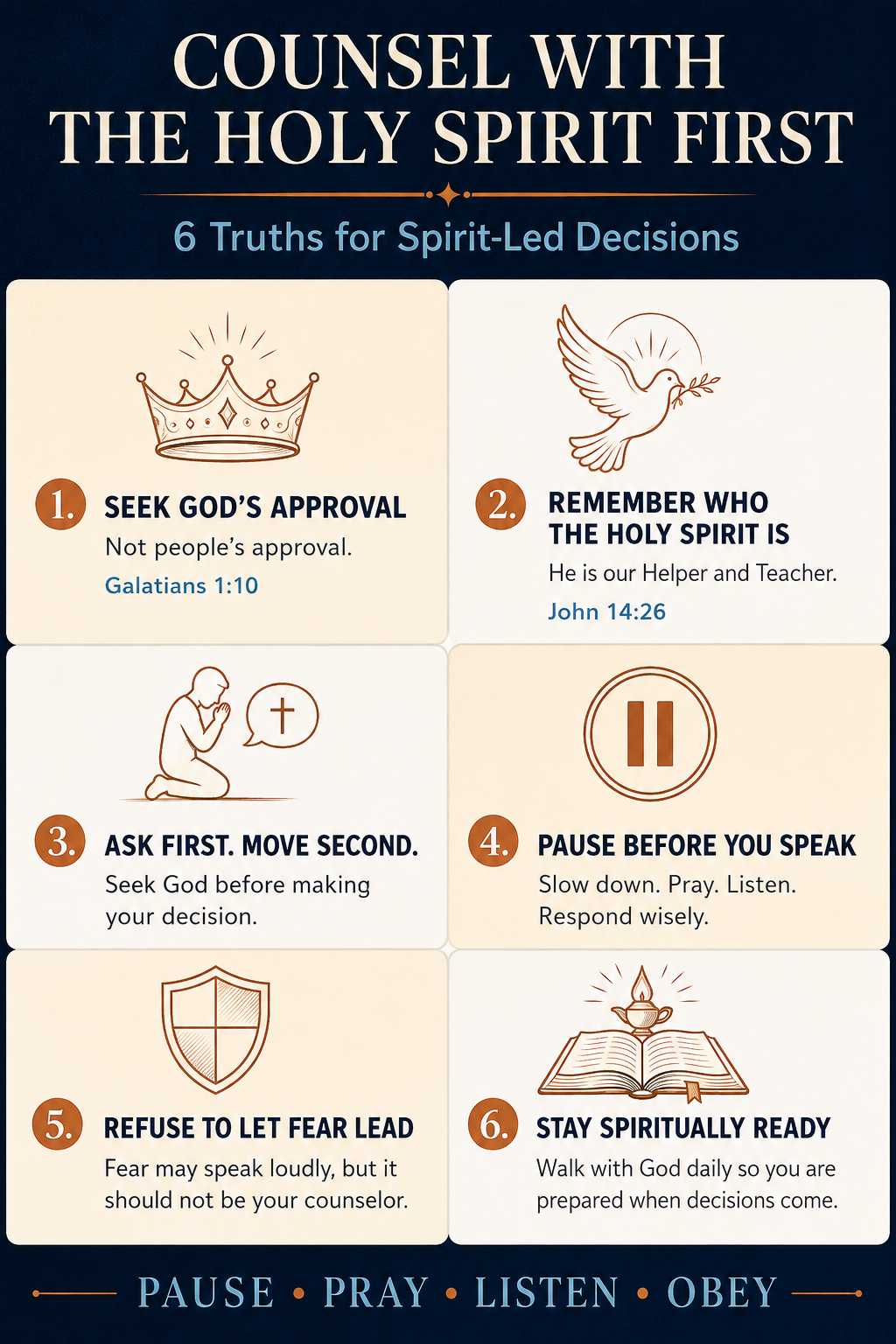
Seek God before making important decisions, responding to pressure, or entering difficult conversations.
Galatians 1:10 reminds us to seek God’s approval rather than live for the approval of people.
John 14:26 shows that the Holy Spirit is our Helper and Teacher who brings Christ’s words to our remembrance.
Biblical guidance is not based on feelings alone; the Holy Spirit leads in harmony with God’s Word.
Pause before you speak or act so you can pray, listen, and respond with wisdom.
Do not allow fear to become your counselor or control your decisions.
Colossians 1:9–13 connects knowing God’s will with spiritual wisdom, faithful living, endurance, and gratitude.
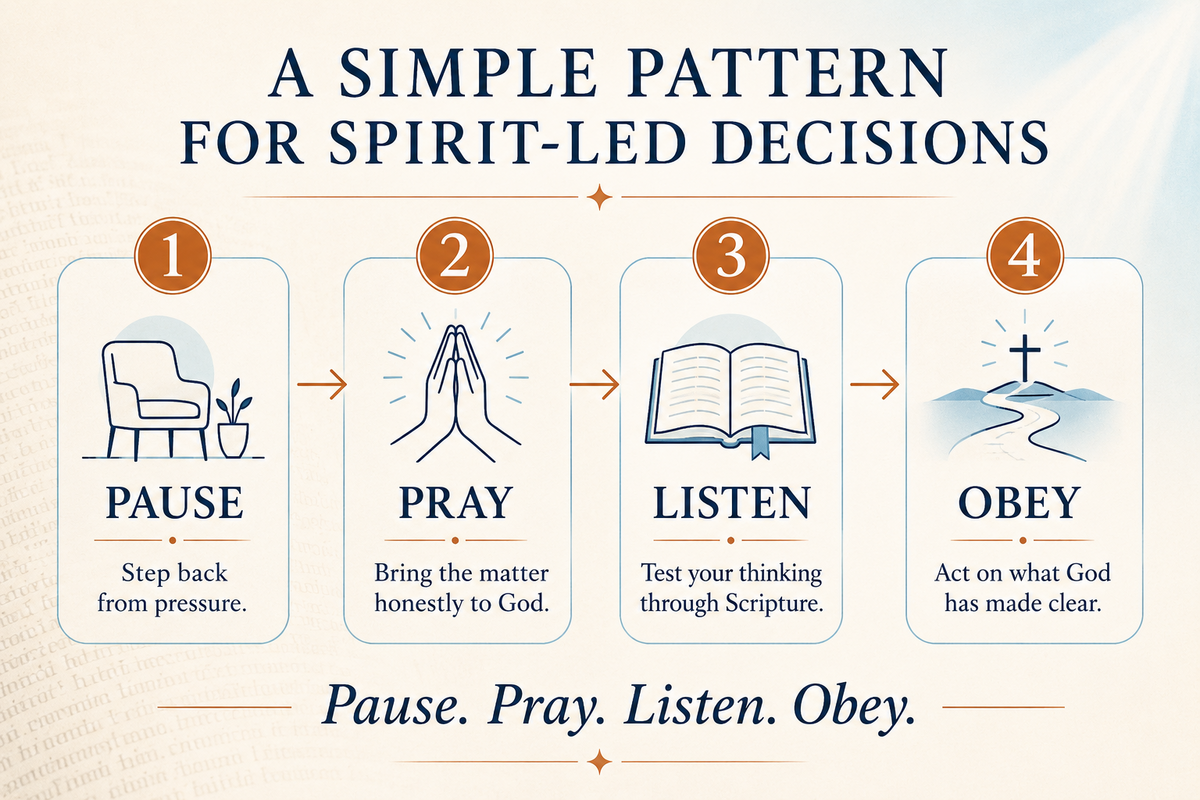
A simple pattern for Spirit-led decisions is: Pause. Pray. Listen. Obey.
The goal is not merely to get the outcome we want, but to make choices that honor God.
What Does It Mean to Counsel With the Holy Spirit First?
To counsel with the Holy Spirit first means that we do not allow pressure, fear, emotion, or the opinions of other people to have the first and strongest voice in our decisions.
Instead, we turn our attention toward God.
That does not mean Christians should ignore wise advice from others. It means human advice must never replace God’s truth. Our first concern should not be, “What will people think?” but, “What will honor the Lord?”
Many mistakes happen because we act first and pray later. We make a decision, speak our mind, sign an agreement, start a relationship, or respond emotionally. Then, after things become difficult, we ask God to help us repair the situation.
There is a better way.
Seek God first. Then make your move.
Seek God’s Approval, Not People’s Approval
Galatians 1:10 challenges us to examine whom we are trying to please.
In its context, Paul was defending the truth of the gospel. He refused to change his message simply to gain the approval of people. His commitment to Christ mattered more than popularity.
That principle also challenges us today.
People can become so concerned about being accepted that they make decisions based on applause rather than obedience. We may ask:
Will people agree with me?
Will this make me look successful?
Will someone be disappointed in me?
Will people understand my decision?
Those questions may matter, but they cannot be our highest authority.
Our calling comes from God. Our responsibility is to remain faithful to Him.
When the desire for human approval controls us, it becomes difficult to follow God when obedience is uncomfortable. A servant of Christ must be willing to do what is right even when it is not popular.
The Holy Spirit Is More Than a Feeling
John 14:26 presents the Holy Spirit as a personal Helper who teaches and brings the words of Jesus to remembrance.
The Holy Spirit is not simply an emotion, an atmosphere, or a spiritual force. Jesus spoke of Him personally. He teaches. He reminds. He helps.
This matters because biblical guidance is more than following whatever we happen to feel at the moment.
Emotions change quickly. Fear can make a safe situation appear dangerous. Excitement can make an unwise choice look wonderful. Frustration can cause us to say something we later regret.
The Holy Spirit does not lead us away from the truth God has already given in Scripture.
That is why learning the Bible is so important. The more of God’s Word we understand, the more biblical truth the Holy Spirit can bring to our remembrance as we face real decisions.
We should never treat every thought or impression as though it were a direct message from God. Instead, we prayerfully submit our thinking to Scripture and ask the Holy Spirit to help us understand and obey what God has revealed.
Ask First, Move Second
One of the simplest lessons from this message is also one of the most practical:
Ask first. Move second.
We often reverse that order.
We act quickly because we feel pressured to give an answer. We assume that if an opportunity is available, we must take it. We may believe that waiting shows weakness.
But sometimes wisdom looks like a pause.
Before sending the text, pause.
Before making the commitment, pause.
Before giving an angry response, pause.
Before making the purchase, pause.
Before walking away from something important, pause.
A pause creates room for prayer, reflection, and biblical wisdom.
It gives us an opportunity to ask:
“Holy Spirit, what would You have me do?”
Then we should open our hearts to the truth of God’s Word instead of demanding that God approve a decision we have already made.

Pause Before You Speak
Words carry consequences.
Once spoken, they cannot always be taken back. A few careless sentences can damage trust that took years to build.
That is why seeking God is important not only before major life decisions but also before everyday conversations.
When emotions are high, slowing down can be an act of spiritual maturity.
Before answering, ask:
Is what I am about to say true?
Is it necessary?
Is my motive to help, or simply to win?
Am I speaking from wisdom or from anger?
Am I responding in a way that reflects Christ?
We do not need to fill every silence. Sometimes the wisest response is to wait until our emotions are under control and our hearts are ready to respond with grace and truth.
Refuse to Let Fear Become Your Counselor
Fear has a powerful voice.
It tells us to protect ourselves at any cost. It predicts the worst possible outcome. It convinces us that we must act immediately because everything will fall apart if we do not.
Fear may alert us to a real concern, but fear should not become our master.
When fear leads the decision, we often lose clarity.
Seeking the Holy Spirit does not mean ignoring reasonable concerns or refusing to prepare wisely. It means that fear does not get the final word.
We can bring our fears before God and ask Him for wisdom, strength, and clarity.
Sometimes the right choice will still be difficult. Spiritual peace does not always mean that circumstances become easy. But we can move forward knowing that our goal is obedience rather than simply escaping discomfort.
Stay Spiritually Ready
Wise decisions are easier when seeking God is already part of our daily life.
If we only pray when there is a crisis, we may struggle to recognize the biblical principles that should guide us.
Spiritual readiness is developed before the emergency arrives.
Read Scripture consistently.
Pray regularly.
Worship God when life is calm as well as when life is difficult.
Practice obedience in ordinary situations.
The goal is not to become so spiritually focused that we neglect practical responsibilities. It is to become so rooted in Christ that our practical decisions are shaped by biblical truth.
Colossians 1 Shows Us What Spiritual Wisdom Looks Like
Colossians 1:9–13 gives us a helpful picture of spiritual maturity.
Paul prayed that believers would grow in the knowledge of God’s will with wisdom and spiritual understanding. But that knowledge was not intended to remain only in their minds.
It was meant to affect how they lived.
Godly wisdom produces a worthy walk.
It leads to fruitful service.
It strengthens believers to endure with patience.
It produces gratitude toward the Father.
Knowing God’s will is not mainly about discovering hidden information concerning every future event. It is about becoming the kind of person who knows God’s truth and lives faithfully because of it.
The more we know God through His Word, the better prepared we are to make decisions that honor Him.
Four Practical Ways to Seek the Holy Spirit Before You Act
1. Pause Before Reacting
Do not allow pressure to force you into an immediate response when a response is not required.
Give yourself time to pray and think.
2. Pray Before Deciding
Bring the matter honestly before God.
Ask Him to expose selfish motives, fear, pride, or the desire to please people.
3. Listen Through God’s Word
Do not depend only on a feeling.
Consider what Scripture clearly teaches. The Holy Spirit will never guide you in a direction that contradicts God’s Word.
4. Obey What God Has Made Clear
Sometimes we keep asking for guidance because we do not like the answer Scripture has already given.
Once God’s Word has made our responsibility clear, spiritual maturity requires obedience.
This Week’s Challenge
Before making an important decision, entering a difficult conversation, or reacting to pressure, stop and pray:
“Holy Spirit, what would You have me do?”
Then take time to examine your motives and consider the truth of Scripture.
Do not ask merely for God to bless what you have already decided.
Ask for wisdom to choose what honors Him.
Frequently Asked Questions
How can I know whether the Holy Spirit is guiding me?
Begin with Scripture. The Holy Spirit will not lead you to disobey what God has already revealed in His Word. Prayer, biblical wisdom, and careful examination of your motives can help you make wise decisions. A strong feeling by itself is not proof of divine guidance. Seek to know God’s Word well enough that your thinking is shaped by biblical truth.
Should Christians seek advice from other people?
Yes. Seeking God first does not mean refusing wise counsel. The danger comes when human approval becomes more important than obedience to God. Mature believers, pastors, and trusted Christian leaders can offer helpful perspective, but their advice should remain consistent with Scripture. We seek God first while remaining humble enough to receive sound counsel.
What should I do when I pray but still do not know what decision to make?
Do not force an answer simply because you want certainty. If possible, wait and continue praying. Follow what Scripture clearly teaches, consider your responsibilities, examine your motives, and use the wisdom God has already given you. Not every decision comes with a dramatic spiritual impression. Sometimes faithfulness means making a responsible choice while trusting God with the outcome.
Does John 14:26 mean the Holy Spirit will tell me exactly what to do in every situation?
Not necessarily. In John 14, Jesus was speaking to His disciples and promising that the Holy Spirit would teach them and bring His words to their remembrance. The passage clearly shows the Spirit’s personal ministry, but it should not be used to treat every private impression as divine revelation. Christians should test their thinking by Scripture rather than assuming every thought came from God.
Is feeling afraid a sign that I am outside God’s will?
No. Fear or nervousness by itself does not prove that a decision is right or wrong. People can feel afraid while doing the right thing, and they can feel comfortable while making an unwise choice. Fear should not control the decision. Bring your concerns to God, examine the situation carefully, and allow biblical truth rather than emotion alone to guide your response.
Final Thoughts: Seek God Before You Make Your Move
The message is easy to remember:
Pause. Pray. Listen. Obey.
Do not wait until a decision falls apart before seeking God.
Do not let the need for approval control you.
Do not let fear become your counselor.
Do not treat the Holy Spirit as an emergency resource whom you consult only when you are in trouble.
Walk with God daily. Learn His Word. Develop a life of prayer. Then, when an important moment arrives, you will be better prepared to respond with wisdom.
Counsel with the Holy Spirit first. Seek Him first, and then move forward in faithful obedience.